
The Waiting Room
On sensing time instead of navigating it

Time is the substance I am made of. Time is a river which sweeps me along, but I am the river; it is a tiger which destroys me, but I am the tiger; it is a fire which consumes me, but I am the fire.
- Jorge Luis Borges
I have been waiting. I am waiting. When people ask me how I am, I tell them I am stuck in a waiting room. The news I am waiting for is not life-or-death, but I did not anticipate needing to wait so long for it, which, of course, makes the waiting infinitely more irksome.
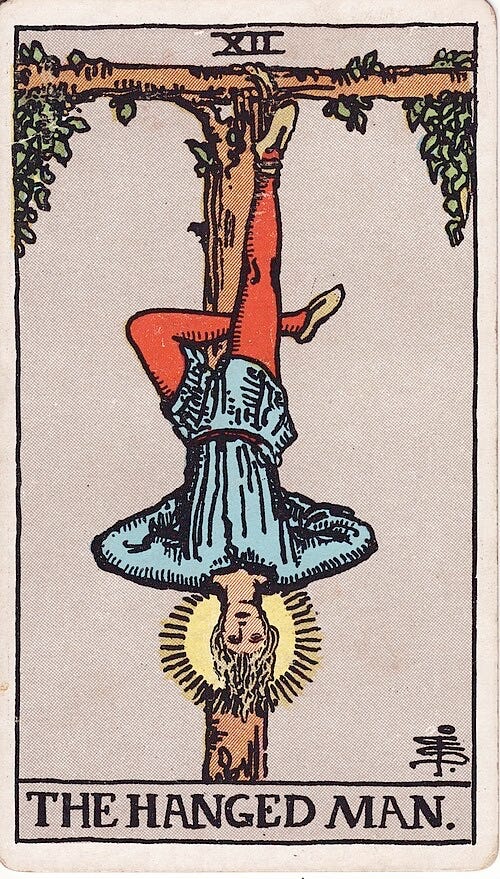
We often speak of time as something to be “navigated,” as if it’s a substance we can steer a ship through. If so, my ship has run aground and the tide is working against me, pushing me ashore and stranding me on an island I have no interest in exploring. I pull tarot cards every morning, and I keep drawing the Hanged Man, a symbol of stuckness. In the Rider-Waite depiction of this card, a man hangs upside down from a branch by his ankle, his face strangely serene given his condition. One way to interpret the card’s advice is to surrender to your current circumstances. I refuse to raise the white flag.
If you’ve been following this newsletter for a while, you know that I’m particularly interested in our sensory experience of time. I prefer to think of time as something that can be sensed rather than navigated. “Waiting, as a specific temporal experience, is characterised by elongation,” write the authors of a study on waiting. The authors are specifically interested in the experiences of women living with breast cancer, people who are in a much more literal—and life-altering—waiting room than me. “Patients” and “patience,” I learn, derive from the same Latin root: patientia,,“the quality of suffering or enduring; submission.” The study maps commonalities in the patients’ experience of time, and I was most struck by how of all of them spoke about the way waiting conjures a “thickening” of time. “Despite their brevity in terms of clock time, these moments can hold tremendous significance, capable of altering the perception of time itself and intensifying emotions like fear,” the authors note. How, then, to thin it out? Lighten it up? I envision a magician — another tarot card I’ve been pulling a lot lately — who can work with this invisible substance, bending it to their will.
The study authors suggest their own kind of magic: a “waiting practice” that can help you recapture a sense of “temporal agency.” Some of the patients’ waiting practices included yoga, establishing routines, and actively researching their particular illness. None of these practices sounded appealing to me; I was hoping for something more esoteric, a ritual instead of a routine. “This waiting work helps to relieve the burden of waiting,” the authors write, “Although it should be noted that the burden of waiting is always there.”
Fresh off a divorce at 50 and making a new life for herself and her daughters in London, writer Deborah Levy bought a clock that plays the song of a different bird every hour. “In the morning at seven the wren made its call to the real birds singing in the dark winter trees,” she writes in “The Cost of Living,” my favorite of her memoir trilogy. “At 4pm it was dark again when the great spotted woodpecker began to drill and drum. Returning home at night I could sometimes hear the nightingale.”
Levy’s memoir is less about the particularities of her divorce, and more about the difficulty of claiming your desires as a woman and writer. It is also, of course, about time: “To unfold any number of ideas through all the dimensions of time is the great adventure of the writing life.” I re-read the memoir recently while in the middle of another book more explicitly about time: “The Fullness of Time: Marking the Day by Birdsong, Blooms, Shadows and Stars.” The book explores the joy of re-learning ancestral ways of measuring time by tuning into natural rhythms: the changing light in the landscape and the movements of plants and animals.
In one chapter, author Cathy Haynes traces our obsession with ornithological clocks, such as the “cuckoo clock,” back to the mid-1800s. She notes how English journals excitedly reported the news that a German man had invented a clock that played different birdsong at precise half-hour intervals. Haynes wondered why the clock was thrilling enough to be news for 19th century city-goers: “possibly it seemed delightful and curious because it appears to bridge two remote entities, the abstract calculative time of the clock and the vivid sensory qualities of time given by the rhythms of living creatures.” In reality, birdsong in nature cannot be so neatly mapped to clock time; what time a bird sings depends on the seasons, the presence of other species, and its habitat, so often changing with climate fluctuations. However, there there are some patterns: the birds that sing first at daybreak are often ones that see better in low light, like the large-eyed blackbird in the UK. Where I live in Northern California, the robins and the mourning doves kick off the morning chorus.
For a while I was puzzled by Levy’s decision to buy a bird clock. This eccentricity didn’t square with my image of the chic Booker Prize finalist who wore a pearl necklace everyday. But then I realized Levy was in her own kind of waiting room. Soon after Levy moves out of the family home she shared with her ex, her mother falls fatally ill. “I lay awake all night waiting for a call from the hospital, each hour marked by the call of the various birds on my bird clock,” she writes in her memoir. “The nightingale sang just before midnight, as if it were perched in the boughs of the dripping tree in the car park.”
Reading the passage, I related to that need to be accompanied in time, the kinship of the nightingale in those dark, inky hours, and the recognition, in grief, that we are here to sense time, not navigate it. It was a kind of “waiting practice” I could finally understand.
Thanks so much for reading and supporting my work. I’ll be back next week with another Making Sense interview, this time with a flower farmer. This waiting period has given me lots of time to think about how I want to show up in this space, so there will be some upcoming changes to the format and schedule. All good things, promise. Stay tuned.
xx
K
P.S. If you’re a new subscriber to the newsletter (I’ve noticed a few dozen new folks over the past few weeks - welcome!!), this newsletter is all about celebrating the senses. I share interviews with artists and thinkers about their relationship to the senses and make them bouquets based on our conversations. And occasionally, I write essays like this one about the senses in literature, history and culture. You can read my introduction to the newsletter here.
I’ll have to check out The Fullness of Time. Thanks for your post!